
-
×
 Geisha in red kimono kokeshi Babushka Matryoshka nesting Doll 1 × $89.95
 -
×
Klava in blue and hot pink Babushka Matryoshka nesting Doll 1 × $79.95
-
×
Christmas décor Ivan the Terrible Army XVI 5-set BOX SET 1 × $44.95
-
×
Marusya with baby light blue dress small Babushka Matryoshka nesting Doll 1 × $54.95
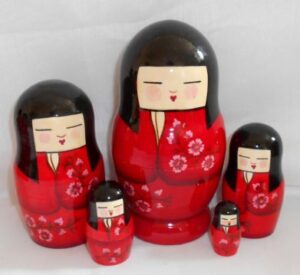 Geisha in red kimono kokeshi Babushka Matryoshka nesting Doll
 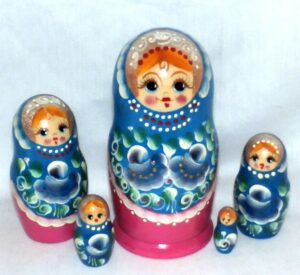 Klava in blue and hot pink Babushka Matryoshka nesting Doll
 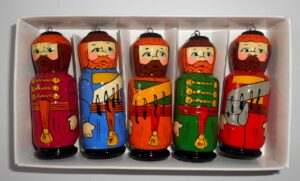 Christmas décor Ivan the Terrible Army XVI 5-set BOX SET
 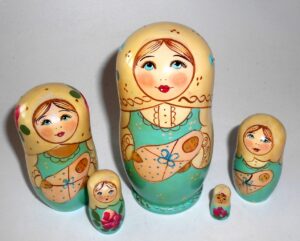 Marusya with baby light blue dress small Babushka Matryoshka nesting Doll
Luxury Matryoshka Dolls — The Finest Russian Nesting Dolls You Can Own
At the highest level of the craft, a master artisan can spend a full week painting a single collector set. The gold leaf is real. The faces are portraits. The smallest piece is no larger than a thumbnail — and painted with the same care as the largest. This is what luxury matryoshka look like.
The word luxury is used carelessly in retail. In the world of Russian nesting dolls, it has a precise meaning: a matryoshka that sits at the intersection of folk tradition and fine art, made by a named master artisan working at the limit of what the medium allows. These are not simply larger or more expensive versions of the dolls sold in souvenir shops. They are a different category of object entirely — closer in spirit to a signed limited-edition print or a piece of studio ceramics than to a decorative trinket.
Australia has very few specialist sources for this calibre of matryoshka. The high-end, upmarket and limited-edition collection at Dolls In Dolls represents nearly two decades of direct relationships with artisan workshops in Sergiev Posad — Russia’s most prestigious centre of matryoshka craft. Every piece in that selection has been chosen personally for the quality of its painting, the depth of its lacquer, and the standing of its maker.
This article explains what makes a matryoshka genuinely luxury grade, how to read the signals of quality when you encounter them, and why the finest pieces are worth understanding on their own terms.
The Craft Hierarchy: Production, Studio, and Master Grade
Russian nesting doll workshops have always operated across clearly understood grades of quality. The distinction is not marketing — it reflects real differences in the time invested, the skill level of the painter, and the complexity of what is being attempted.
Production grade
The foundation of the market. Genuine hand-painting by trained artists working efficiently through established patterns, producing multiple sets per day. The quality is authentic — these are not imitations — but the painting is economical. Faces are expressive rather than individuated; floral patterns are confident rather than intricate. Production-grade dolls are the five-piece sets most people encounter first, and they are beautiful objects in their own right. They are simply not working at the limit of what the craft can do.
Studio grade
A step above: dolls painted more slowly, with greater attention to facial character and compositional originality. A studio-grade painter may spend multiple days on a single set. Shading becomes more nuanced, backgrounds more complex, and the relationship between pieces more considered — each figure distinct in expression while reading as part of a coherent family. The faces begin to look like specific people rather than archetypes.
Master grade
At this level — represented in the Dolls In Dolls collector selection — a senior artisan trained over decades within a family atelier may spend a week or more on a single set. The outermost face is a true miniature portrait: graduated shading from forehead into hairline, catchlights in the irises, a suggestion of bone structure beneath the paint. The costume carries landscape or architectural detail of a kind that requires the confidence of a trained painter. These are signed works, often accompanied by provenance documentation, and they are produced in very limited numbers.
“A master does not paint faster with experience. She paints more slowly — because she sees more.”
Gold Leaf, Gold Paint, and What the Difference Looks Like
Gold detailing is the single most visible marker of a luxury matryoshka — and the most misunderstood, because not all gold is the same material or the same quality.
Gold paint
A metallic pigment — typically mica or bronze powder — mixed into a lacquer base and applied by brush. The result is bright and attractive: a clean, reflective band that reads clearly as gold. On production and studio dolls this is entirely appropriate. But under ambient light, gold paint is flat. It does not shift or deepen as the angle of view changes. What you see at first glance is what you see under any conditions.
Real gold leaf
Beaten to extraordinary thinness and applied in sheets to the painted surface with an adhesive size, then burnished smooth. The difference from gold paint is not subtle — it is the difference between a photographic print and an oil painting. Gold leaf is warmer in colour, dimensional in quality, and alive to light in a way that changes as you move the doll. Under a lamp it glows rather than sparkles. The application edges are fractionally irregular, because a human hand laid them, which gives ornamental borders a vitality that printed or stencilled work cannot replicate. On luxury matryoshka, gold leaf appears on halos, crown details, the structural borders of caftans, and the ornamental frames of architectural scenes.
The tilt test. Hold the doll under a single light source and tilt it slowly. Gold paint stays uniformly bright — the reflection moves but the quality does not change. Real gold leaf shifts between warm amber and bright yellow as the angle changes, as if the surface is breathing. The edge definition also differs: gold leaf borders are slightly soft; gold paint borders are sharp and even.
Now available
High-End & Limited Edition Matryoshka
Signed master-grade sets, gold-leaf finishes, and collector pieces sourced directly from Sergiev Posad workshops. A curated selection unlike anything else available in Australia.
View the Collection →What to Examine on a Luxury Matryoshka
Assessing a high-value piece is a detailed and systematic process. These are the elements that separate a genuine luxury matryoshka from something merely expensive.
The face
More than any other single element, the face reveals the quality of the painter. Look for graduated shading from forehead into hairline; a convincing orbital structure beneath the skin rather than a flat disc of colour; the whites of the eyes tinted slightly warm rather than painted in pure white (which reads as cold against a warm-toned face); catchlights in the irises; and — most telling — an expression that carries individual character. Mass-produced faces are archetypes. A master-painted face looks like a specific, identifiable person. This quality is not a matter of detail volume. It is a matter of understanding.
The lacquer
Luxury matryoshka receive more lacquer coats than production pieces — often eight or more — with fine sanding between each coat. The optical result is depth: the paint appears to sit beneath the lacquer surface rather than on top of it, as if seen through a thick lens. Colours appear richer and more saturated than they would uncoated. When you move a finely lacquered doll in light, you become aware that the surface has dimension. This is not achievable in fewer coats, and it cannot be rushed.
The fit and the turning
A luxury set is turned with greater precision than a production piece. Each half of each pair should meet with a friction that feels calibrated — enough resistance to hold the doll closed during normal handling, smooth enough that the join opens with a single clean motion and no force. In a collector set of fifteen or twenty pieces, every single pair should feel identical in this quality. That consistency requires a more careful and time-consuming turning process and speaks to the overall standard of the workshop.
The smallest piece
This is the definitive test. On a production doll the innermost figure is a tiny unpainted cylinder — a conceptual gesture toward the nesting idea. On a luxury collector set, the smallest piece is painted with exactly the same care as the largest: a complete face, costumed body, and finished base, often no bigger than a cherry. The commitment to finish at the scale of near-invisibility is the clearest possible signal of a master’s intent. If the smallest piece is an afterthought, the set is not a luxury piece regardless of the price on its label.
The signature and provenance
Signed works from named artisans are the foundation of the collector market. A signature on the base — in the artisan’s own hand, ideally accompanied by the atelier location and date — is both an authentication and a provenance record. The finest pieces include a separate certificate of authenticity. If a doll is priced as luxury but carries no signature, no maker’s mark, and no provenance, it deserves significant scrutiny regardless of how it looks in a photograph.
✦ ✦ ✦
Shop by category
Limited Edition Matryoshka: Exclusivity with Documentation
A limited-edition matryoshka is produced in a numbered or formally documented run by a specific named artisan or atelier. Because every piece is hand-painted, no two are ever identical — but a limited edition formalises that exclusivity with documentation: a numbered certificate, the artisan’s signature on the base, and often a statement of the total edition size.
Some limited editions are thematic — tied to a particular Russian folk tale, a historical or commemorative subject, a specific seasonal iconography, or a collaboration with an individual artist working outside the mainstream matryoshka tradition. Others are simply the best work of a senior master in a given period, produced in small numbers because that is all the time and the standard allow.
The limited-edition selection at Dolls In Dolls is updated as new pieces become available from our artisan contacts. Because genuine limited editions are by definition scarce, popular sets sell without reorder options. If something in the collection speaks to you, it is worth acting on that quickly.
Luxury Matryoshka as Gifts and Corporate Commissions
A fine matryoshka occupies a rare position in the gift market. It is at once decorative and meaningful, culturally specific and universally legible — an object that invites handling (it opens, it nests, it rewards attention) while also functioning as a contemplative artwork. Very few gifts at any price achieve all of these simultaneously, which is why luxury nesting dolls have long been favoured at the highest level of diplomatic and corporate exchange.
For corporate gifting, a signed collector set presented in its original lacquered box with documentation communicates connoisseurship and cultural literacy in a way that wine, hampers, or branded merchandise cannot. It is a gift that sits on a desk or shelf for years and is explained and shown to visitors repeatedly. The brand impression it carries is long-lived and singular.
For weddings and significant anniversaries, a personalised matryoshka — painted with the couple’s likenesses, or a traditional set chosen for its iconographic resonance — is a gift whose meaning grows rather than diminishes over time.
For corporate commissions — company insignia, executive portraits, commemorative subjects — we work directly with our Sergiev Posad atelier contacts to match the brief to the right painter and format. Lead times from brief confirmation to delivery in Australia are typically six to ten weeks. Contact us to begin a conversation.
Why the Number of Active Masters Is Shrinking — and Why It Matters
The pool of active master-grade matryoshka painters — artists working at the highest level of the tradition with decades of atelier training — is genuinely finite and currently contracting. The tradition of passing the craft from mother to daughter within a family workshop, which sustained the highest grades of the art through the Soviet period and beyond, is not being replicated at the same rate in younger generations. Economic pressures, the dominance of machine-printed imitations in tourist markets, and the simple difficulty of building a practice at this level of skill mean that the number of masters producing collector-grade work is smaller today than it was twenty years ago.
This matters for collectors and serious buyers in a direct and practical way: the output of the finest artisans is already limited by the time the work demands, and that output is becoming rarer. A signed collector set from a named Sergiev Posad master is not simply a beautiful object. It is a document of a living tradition at a specific moment — one that will not be infinitely reproducible.
Caring for a Luxury Matryoshka in Australian Conditions
A fine matryoshka warrants the same care as any significant decorative object. The lacquer is robust, but ultraviolet light will bleach natural pigments over time. Display luxury pieces away from direct sun — in a cabinet with UV-filtering glass if the pieces are particularly fine. Dust with a dry sable or squirrel-hair brush, never a damp cloth and never any chemical product.
Temperature and humidity stability are more critical for luxury pieces than for production dolls, because the heavier lacquer coats are more sensitive to differential expansion. Australia’s combination of intense summer heat, reverse-cycle air conditioning (which can reduce indoor humidity to damaging levels), and coastal moisture swings in Sydney, Melbourne, and Brisbane creates real pressure on heavily lacquered wooden objects. A stable indoor humidity between 40 and 55 per cent is ideal. A small room humidifier near the display cabinet is a simple and effective precaution in dry interior climates.
Do not store valuable matryoshka fully nested for extended periods. Interior pieces compressed inside the outer shell over months can become difficult to separate, particularly if any humidity cycling has occurred. Store fine pieces with each pair slightly open, wrapped individually in acid-free tissue, in a cool and dark space. The full preservation guide — including what to do if a lacquer surface develops a hairline crack or a joint becomes stiff — is available in the doll care guide.
Explore the High-End & Limited Edition Collection
Signed master-grade sets, real gold-leaf finishes, and collector pieces from Sergiev Posad — delivered anywhere in Australia.
Shop Luxury Matryoshka Commission a Custom Piece