
-
×
 Kids Apron yellow and black Babushka 1 × $34.95
 -
×
Our Lady of Perpetual Help in red with stand XLarge 1 × $199.95
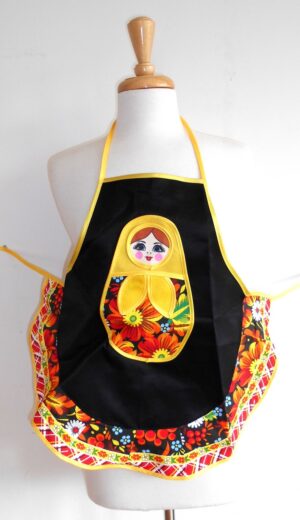 Kids Apron yellow and black Babushka
  Our Lady of Perpetual Help in red with stand XLarge
Dolls In Dolls · Learn & Play
More Than a Pretty Shelf Toy
Why Russian nesting dolls are quietly one of the best educational toys you can put in front of a toddler or preschooler — and how to use them at home.
Matryoshka dolls have always been loved for their beauty and their history. But spend five minutes watching a toddler stack, unstack and reassemble a set, and you’ll notice something else going on: real learning. Early childhood educators and Montessori practitioners have long used nesting dolls as a hands-on teaching tool, and it turns out a good set from your own shelf can do the same job as anything in a classroom.
Here’s how a simple set of nesting dolls builds real developmental skills — plus some easy games and activities you can try at home tonight.
❀
What Nesting Dolls Actually Teach
Size & Visual Discrimination
Lining dolls up from biggest to smallest teaches seriation — comparing and ordering objects, a foundation skill for later maths.
Fine Motor Skills
Twisting each doll open and nesting it back inside the next size up takes real hand strength and coordination to master.
Counting & Early Maths
A single set is a natural counting tool. Combine two or three sets for comparing quantities and even early multiplication.
Comparative Language
Big, bigger, biggest, small, smaller, smallest — vocabulary straight from the early primary maths curriculum, made physical.
Storytelling & Imagination
Each doll becomes a character. Older kids can invent and narrate their own tales, smallest doll as the hero.
Culture & Geography
A gentle introduction to another part of the world — where matryoshka dolls come from and the tradition behind the craft.
Good to know: Early learning specialists generally suggest nesting dolls as appropriate from around 18 months for simple matching play, with language and counting activities better suited from age two and up. As with any small toy, always supervise play with the smallest piece in a set.
❀
Five Easy Home Activities
1
Matching
Trace the base of each doll onto paper and match each doll to its outline.
2
Ordering
Line the dolls up biggest to smallest, then challenge your child to reverse the order.
3
Size Vocabulary
Hold up one doll and ask your child to find one bigger or smaller.
4
Counting
Count the dolls aloud together, then match a numeral card to each one.
5
Storytelling
Invent a short tale where each doll plays a character, smallest to biggest.
❀
Buy a Set Ready to Play With
Beautifully Finished, Straight Out of the Box
Browse our Traditional Classic Dolls for the timeless painted look, or our Animals & Birds and Cartoons Kids Corner ranges for something bright and playful that’s especially appealing to little hands. For a more delicate, hand-decorated finish, our Floral Babushkas and Woodburn Dolls make gorgeous shelf pieces that double as a teaching tool once the kids are old enough to handle them carefully.
Or Make a Montessori-Style Set Together
Simple, Calming, Hands-On
Many Montessori-inspired homes prefer a plain, natural-wood look — simple, solid colours rather than a busy painted design, so the toy’s shape and size do the teaching rather than the decoration. It’s an easy project: a couple of coats of non-toxic paint on a set of blank dolls, left to dry fully, is genuinely all it takes.
Start with our Nesting Dolls DIY blanks for a classic shape, or the Colour Me In range for a guided outline already in place. Our Sets of Cuteness and Magic Forest & Mushrooms blanks are lovely for building a whole world of characters for storytelling play, and the Peg People and Décor Boxes are a quicker option for younger siblings to join in on.
❀
A Lovely Gift for Little Learners
Because they combine open-ended play with real developmental benefit, a nesting doll set makes a thoughtful gift for a birthday, christening, or first Christmas. Our Christmas Nook collection is worth a browse if you’re planning ahead for the festive season, with pieces that work equally well as a keepsake or a hands-on toy.
❀
Frequently Asked Questions
What age are nesting dolls suitable for?
Simple matching and stacking play is generally suitable from around 18 months, with language, counting, and comparison activities better suited to children two years and up. Always supervise play with young children, as the smallest piece in a set can be a choking hazard.
Do painted or unpainted dolls work better for learning?
Both have a place. A finished, painted set is beautiful and immediately playable, while a plain or self-painted set in simple colours can help younger children focus purely on size and order without the distraction of a detailed pattern.
How many dolls should a first set have?
A 3 to 5 piece set is plenty for toddlers and early learners. Larger sets are wonderful for older children ready for a bigger counting or ordering challenge.
Bring the Learning Home
Explore our full range of matryoshka and babushka dolls — from ready-painted keepsakes to blank sets perfect for a hands-on family project.
Visit Dolls In Dolls